How Much Do New Gutters Cost in Northern Virginia?
The number you came for: most whole-house seamless gutter replacements in Northern Virginia run $1,200 to $3,000 installed with us, with smaller homes landing at the low end. Compared with a roof or siding project, gutters are refreshingly affordable, which makes it strange how mysterious gutter pricing usually is. This guide lays out exactly what moves the number, when bigger gutters are worth it, and how leaf protection changes the math.

Gutters due for replacement? See our seamless gutters and leaf protection, or request a free estimate.
Gutter replacement cost at a glance
| Project | Typical installed range |
|---|---|
| Smaller single-story homes | Low end of $1,200 to $3,000 |
| Most whole-house seamless replacements | $1,200 to $3,000 |
| Larger homes, complex rooflines, guards added | Upper end of the range and above |
These are planning ranges from the projects we actually install. A free at-home estimate converts them into a firm written price for your house, and every house is different, so if yours does not fit neatly into a row, reach out and we will price what you actually have.
What moves the number
Linear feet and stories
Gutters are priced by how much gutter your roof needs, so a sprawling rambler can genuinely need more linear feet than a compact two-story colonial. Stories matter separately: second-story work means more ladder time and more care, and it prices accordingly.
Corners and downspouts
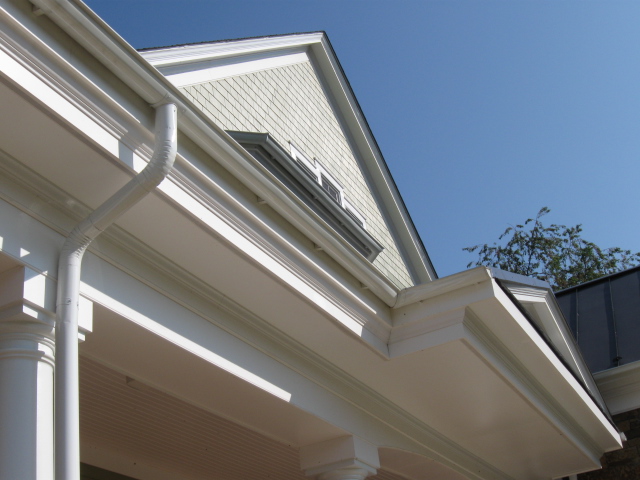
Every corner is a fabricated joint and every downspout is its own assembly, so a cut-up roofline with many inside and outside corners costs more than a simple rectangle with the same footage. Downspout count is also where drainage is won or lost: the right number, in the right places, matters more for keeping water off your foundation than any other single choice.
Placement deserves a sentence of its own. A downspout that dumps beside the foundation has done half its job; the water needs to leave. We plan discharge points around your grading, your walkways, and your neighbors, and on lots with drainage history that planning is the most valuable part of the whole project. It costs nothing extra to put downspouts in the right places; it just takes someone bothering to think about it.
Five-inch or six-inch
Five-inch gutters are the residential standard and handle most Northern Virginia roofs well. Six-inch gutters carry noticeably more water and earn their modest upcharge on large roof planes, steep pitches that shed water fast, and valleys that concentrate flow into a short stretch of gutter. We size to the roof above, not to a default.
Seamless aluminum, formed at your house
Our standard gutters are seamless aluminum, rolled to length on site to fit your roofline exactly. Fewer seams means fewer places to leak as the years pass, which is the entire argument for seamless and the reason sectional box-store gutter rarely competes on lifespan. Aluminum also takes color: modern gutter coil comes in dozens of factory finishes, so the new gutters can match your trim or disappear against it.
Half-round and copper, for the houses that earn them
Standard K-style gutters suit most homes, but half-round gutters bring a classic profile that older and higher-end houses wear beautifully, and copper gutters turn a drainage system into an architectural feature that ages into its patina over decades. Both cost more than standard aluminum and are priced as their own conversation, which is exactly the conversation to have if the house deserves it.
Leaf protection: the add-on that changes ownership
If your house sits under real tree cover, gutter guards end the twice-a-year cleaning cycle, and around here that cycle is no joke. We install contractor-grade Leaf Relief and Englert MicroGuard systems rather than the infomercial variety. Guards add to the project cost, and the cheapest time to add them is while new gutters are going up, since the crew and the ladders are already there. With few trees nearby, guards are genuinely optional, and we will say so.
How to know your gutters are actually done
Gutters rarely fail all at once; they retire slowly, and the signs show up on the house before they show up on the gutters. Look for paint peeling on the fascia board behind the gutter, tiger-stripe stains running down the gutter face, sections pulling away from the roofline, and standing water or plant growth inside the runs. On the ground, look for trenching in the mulch under the roof edge and damp spots at the foundation after rain. Any one of these can be a repair; several together usually mean the system has stopped doing its one job, which is moving water away from the house.
Seams are the other tell on older sectional gutters. Every joint in a sectional system is a future leak, and once the sealant era of a gutter run begins, resealing becomes an annual ritual. That is typically the point where replacing with seamless costs less over the next decade than maintaining what is there.
Should gutters ride along with a roof replacement?
Often, yes. If your gutters are fifteen to twenty years old and the roof is being replaced anyway, doing both in one project means one crew, one disruption, and a roof and drainage system that age on the same clock. If your gutters are newer and healthy, we will tell you to keep them; replacing good gutters to pad a project is not how we operate.
What a gutter quote should include
A complete quote covers removal and disposal of the old gutters, the new seamless runs and downspouts, sealed and properly pitched installation, and cleanup afterward. Pitch is the invisible craftsmanship in gutter work: runs need a slight, consistent slope toward the downspouts, steady enough to move water but shallow enough that the line still reads level from the yard. If a bid undercuts the ranges here by a lot, the difference usually hides in pitch and placement, the two things you cannot judge from the ground until the first hard rain judges them for you. Our written price comes from measuring your actual roofline, and it does not change at the kitchen table. The written price covers everything we can see and measure. If removing the old gutters uncovers rotted fascia boards, that repair is priced at the per-unit rate written on your contract and approved by you before we continue.
Sunshine Contracting is a replacement company; we do not take repair-only jobs, except warranty service on our own installations.
Gutter cost FAQs
How much does gutter replacement cost in Northern Virginia?
Most whole-house seamless replacements run $1,200 to $3,000 installed, with smaller homes at the low end. Linear feet, stories, corners, downspout count, five-inch versus six-inch size, and leaf protection move the number. A free at-home estimate makes it exact.
Are six-inch gutters worth the upgrade?
On large or steep roofs, and anywhere valleys concentrate water into a short run, yes: the extra capacity is cheap insurance against overflow. On modest roofs with gentle pitches, five-inch handles the job and the upgrade buys little. We recommend based on the roof above the gutter, not a one-size answer.
Do gutter guards pay for themselves?
Under real tree cover, generally yes: they end the cleaning cycle and keep gutters flowing through fall instead of overflowing against your fascia and foundation. With few nearby trees they are optional comfort rather than necessity. Adding them during gutter replacement is the least expensive way to get them.
Want the exact number for your house? Schedule a free estimate. We measure the roofline, talk through sizes and guards honestly, and leave a written price that does not change at the kitchen table. Serving all of Northern Virginia from Woodbridge since 1993.